Custom GPT development for business

We build custom GPT solutions that live inside ChatGPT and know your business: a sales GPT that knows your products, a support GPT connected to your knowledge base, a GPT that reads and writes in your CRM and databases. 500+ clients, 15,000+ automations, ISO 27001 certified.

  • Trained on your data
  • Connected to your systems
  • Live in weeks
  • ISO 27001 certified
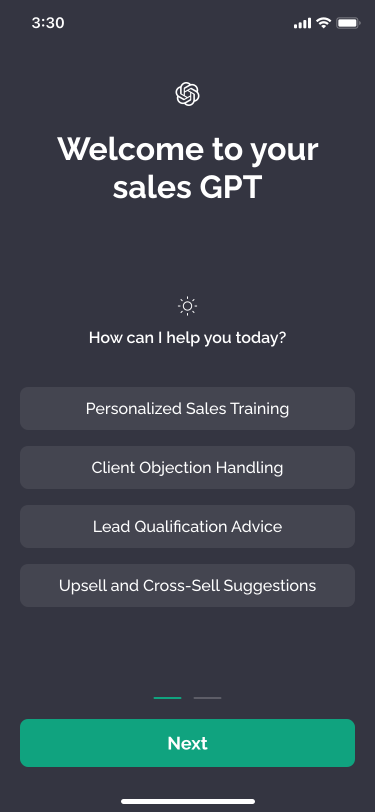
A smartphone screen displaying a 'Welcome to your sales GPT' interface with options for sales training, objection handling, qualification advice, and upsell suggestions.

What is a custom GPT?

A custom GPT is a version of ChatGPT that you configure for one job: it carries your own instructions, your own documents and, through actions, a live connection to your systems. Your team uses it in the ChatGPT interface they already know, but the answers come from your business rather than from the public internet.

Custom GPT development covers four things:

  • Instructions that fix how it behaves, what it refuses and what tone it answers in.
  • Knowledge uploaded and structured so it retrieves the right passage from your policies, products or case files.
  • Actions that call your APIs, so it can look up an order or update a record instead of describing how to.
  • Access decided by you: private to your workspace, shared with clients, or published in the GPT Store.

OpenAI's own guide to creating a GPT covers the builder itself. What it does not cover is the part that decides whether a GPT survives contact with real users: knowledge preparation, evaluation, access control and the API work behind actions. That is the work we do.

Services

Our custom GPT development services

Four pieces of work. Most projects need all four, and the last one is what separates a GPT still in use after six months from a demo nobody opens.

  • Custom GPT build and configuration

    Instructions, behaviour, tone and refusals, written and tested against the questions your people actually ask. This is where a custom GPT builder gets you a prototype and a custom GPT developer gets you something you can hand to a client.

  • Knowledge base and data preparation

    We structure and clean the documents behind the GPT so retrieval returns the right passage, including scanned files and spreadsheets. Pairs with document and contract automation when the source material is contracts.

  • Actions and API integration

    Custom GPT integration with your CRM, ERP, store or internal tools, so the GPT reads live data and writes back. Built on the same connections as our SaaS integration work.

  • Deployment, governance and support

    Access scoping, versioning, evaluation against real questions, and monitoring after launch. We keep it current as your products, prices and policies change.

Benefits

Why choose a custom GPT?

  • Trained on your business

    Get a GPT specialised for your use case, with responses aligned to your internal knowledge, business goals and industry vocabulary.

  • Access live data

    Connect the GPT to your company's tools through actions. It reads real-time information about clients, inventory or bookings and creates new entries straight from a conversation.

  • Works inside ChatGPT

    Custom GPTs run on the ChatGPT website, so your team uses an interface they already know and there is nothing new to roll out.

  • Private or public access

    Choose a private custom GPT that only your organisation can reach, one shared with named clients, or one published in the GPT Store.

  • Fast to deploy

    A focused custom GPT for business is usually live in days rather than months, because the interface and the model are already there.

  • Fits your existing tools

    Your GPT slots into the tools and processes you already run, cutting manual effort instead of adding another tab to check.

The difference

Why is this not just uploading files to ChatGPT?

  • Prepared knowledge, not a folder

    Raw exports retrieve badly. We structure and clean the source material, split it so retrieval lands on the right passage, and remove the outdated documents that quietly contradict the current ones.

  • Guardrails and refusals

    A GPT that answers everything is a liability. We define what it must not answer, what it must escalate, and what it has to cite, then test that the rules hold under pressure.

  • Evaluation against real questions

    We build a test set from questions your team and customers actually ask and measure against it, so "it seems better" becomes a number you can check before launch.

  • Real API actions

    Uploaded files are static. Actions let the GPT check a live order, update a deal or raise a ticket, which is the difference between an answer and a completed task.

  • Access control

    Scoped so people retrieve only what their role permits. This is the part that decides whether a GPT can hold HR, legal or customer data at all.

  • Versioning and upkeep

    Products, prices and policies change. Instructions and knowledge are versioned so you can see what changed and roll back, instead of editing a prompt nobody kept a copy of.

Makeitfuture expertise

Backed by industry-recognised certifications and performance metrics

  • ISO 27001 certified
  • ISO 9001 certified
  • Make.com Platinum Partner
  • Make.com AI Partner of the Year
  • Certified Expert Partner
  • Boost.space Platinum Partner
  • HubSpot Partner
  • Zapier Partner
  • Airtable Gold Services Partner
  • 500+

    Clients

  • 15000+

    Automations

  • 7+

    Years of experience

Use-cases

Custom GPT use cases

These are the custom GPT examples companies ask us for most. Each one is defined by the systems it connects to, which is what decides the build.

01 / 05

  • Custom project management GPT

    A GPT for your team connected to the project tool you already run, whether that is ClickUp, Jira or Airtable. It answers questions about due tasks, reports on the daily workload, and creates, edits or closes tasks on request.

  • Custom sales GPT

    Connected to your CRM (HubSpot, Salesforce, Pipedrive), it helps your team find records, update deals, build reports and review tasks. It can send confirmation codes before revealing sensitive data, so only the right client sees their own. Often paired with wider sales automation.

  • Customer support GPT

    A support GPT on your knowledge base, policies and product data, so first-line questions get a consistent answer with the source attached instead of six different ones. Where the goal is resolving tickets end to end rather than answering questions, we build a dedicated AI customer support agent instead.

  • Compliance GPT

    Rather than handing employees thousands of pages of regulation, a compliance GPT trained on the relevant documents answers their questions, advises on how to complete each form correctly, and walks them through procedures step by step.

  • Document and contract analysis GPT

    For teams working through contracts, case files or tenders. Ask what a clause says across a whole library, get the answer with the source document attached, and have the risky terms flagged against your own checklist. This is the GPT behind our legal knowledge work, and it pairs with document and contract automation.

Integrations

Tools we can integrate with a custom GPT

A GPT becomes useful when it can reach your systems. These are the tools we most often wire into custom GPT actions, through the platforms we partner on.

Also connected through Asana, Trello, Zoho CRM, Stripe, DocuSign, Gmail, Outlook, Supabase and many more. If a tool has an API, a custom GPT action can reach it.

How it works

How custom GPT development works.

  1. 01

    Discovery and use-case scoping

    We pick the one job the GPT must do and agree the number that says whether it worked. Broad briefs produce GPTs that answer everything and are trusted for nothing.

  2. 02

    Knowledge and prompt engineering

    We structure the documents behind it so retrieval lands on the right passage, then write and test the instructions, refusals and tone.

  3. 03

    Build, test and integrate

    We build the GPT, wire up the actions against your APIs, and evaluate it against real questions from your business. Guardrails and access scoping are set here, not after launch.

  4. 04

    Launch, train and support

    We roll it out to your team or your clients, show them what it is good at and where to stop trusting it, then keep it current as your products and policies change.

Custom GPTs vs AI assistants

Both are worth building and they solve different problems. A custom GPT lives inside ChatGPT. An AI assistant lives inside your product.

Feature Custom GPTs AI assistants
Where it runs In the ChatGPT interface, so everyone using it needs a ChatGPT account On your website, in your product, Slack, Teams or WhatsApp, with no ChatGPT account needed
Time to first version Days. The interface and the model already exist Weeks. The interface, retrieval and integrations are all built
Customisation Instructions, knowledge and actions, within what the ChatGPT builder allows Full control of retrieval, model choice, guardrails and interface
Integration depth Actions calling your APIs on request, during a conversation Read and write across CRM, ERP and internal systems, including unattended runs
Model choice Whatever OpenAI ships, on OpenAI's timetable Chosen per task across OpenAI, Claude, Gemini, Mistral and open-source models
Best for Internal teams and named clients who already work in ChatGPT Customer-facing use, or anything embedded in a product you own

Pricing

How much does a custom GPT cost?

Focused custom GPT

popular

One job, your own instructions and a prepared knowledge base, no live integrations. The usual starting point, and typically live in 1 to 2 weeks.

Connected custom GPT

Adds actions against your CRM, store or internal APIs, so the GPT reads live data and writes back, with evaluation and access scoping. Typically 3 to 6 weeks.

Rollout and support

Several GPTs across teams, governance and versioning, plus upkeep as your products, prices and policies change. Billed monthly.

FAQs about custom GPT development

  • How does a custom GPT differ from standard chatbots?

    Unlike a scripted chatbot, a custom GPT reasons over your own material, holds context across a conversation and can call your systems through actions. If you want an assistant that lives in your own product or channels rather than in ChatGPT, that is conversational AI development; for systems that go beyond answering and run a process end to end, see our AI agents that take action.

  • How much does a custom GPT cost?

    A focused custom GPT with prepared knowledge and no live integrations is the usual starting point and is typically live in 1 to 2 weeks. Adding actions against your CRM or internal APIs, with evaluation and access scoping, moves it to a 3 to 6 week build. The three things that move the number are how many systems the actions must reach, how much preparation your knowledge needs, and whether it faces customers or stays internal. We quote fixed-price after a scoping call.

  • How do I build a custom GPT, and when should I hire someone?

    You build one in the ChatGPT builder: give it instructions, upload knowledge, optionally define actions against an API. For a personal GPT over a handful of documents, do it yourself. Bring in a custom GPT developer when it faces customers, touches regulated or sensitive material, needs to write into your systems, or has to keep working as your products and policies change. The build is the quick part; prepared knowledge, guardrails, evaluation and access control are the work.

  • What makes a custom GPT agency worth it over doing it in-house?

    Two things. The first is the failure modes: we have seen where GPTs go wrong (stale documents contradicting current ones, confident answers with no source, actions that write to the wrong record) and design against them up front. The second is the integration work. Actions are ordinary API engineering, and we are a Make.com Platinum Partner with 15,000+ automations behind us, so connecting your CRM, ERP or store is routine rather than a research project.

  • Can I train the GPT on my own data?

    Yes. Documents, past communications and business-specific material all become the knowledge behind the GPT. The preparation matters more than the volume: we structure and clean the source material so retrieval returns the right passage, and remove outdated documents that would otherwise contradict the current ones.

  • What integrations are possible?

    Anything with an API. In practice we most often connect HubSpot, Salesforce, Pipedrive, Airtable, Google Drive, SharePoint, Slack, Microsoft Teams and Shopify, and we orchestrate the more involved flows on Make.com or n8n. See the integrations grid above for the full picture.

  • Can a custom GPT handle multiple languages?

    Yes. The underlying models work across languages, so a GPT can take a question in one language and answer from knowledge written in another. Worth testing per language before rollout: quality is strong in major European languages and thinner in some others, and we check that as part of evaluation.

  • What are the limitations?

    Usage is confined to the ChatGPT website, and everyone using it needs a ChatGPT account: a free account allows limited interactions, a paid one gives full access. You are also inside what the ChatGPT builder allows, so model choice and interface are not yours to control. To run AI on your own website, product or channels instead, explore our OpenAI personal assistant for business.

Still got questions?

Ready to grow and agentify your business?

Let's find together where you can implement AI and automation securely, and built to last.

Book a strategy call
  • Addmark logo
  • Red Club logo
  • Players Poker logo
  • CleanCat logo
  • Capace cu Suflet logo