Compare five contract generation tools by the work they handle: e-signature, sales documents or full contract lifecycle management. See where each fits, what it may cost and which limits to test before you buy.
The right contract generation tool depends on your contract volume, approval rules and the systems that hold your customer or supplier data.
DocuSign, Ironclad, PandaDoc, Agiloft and Juro cover different parts of contracting. Start with the comparison below, then check each product against one real contract workflow in your business.
Compare the five contract generation tools
The pricing column describes each vendor’s published approach as checked in October 2026. Ask for a current quote before budgeting for CLM, integrations or implementation.
| Tool | Best fit | Main trade-off | Pricing approach |
|---|---|---|---|
| DocuSign | Teams that need e-signature and wider agreement workflows | CLM scope needs separate evaluation | Public eSignature tiers; broader plans through sales |
| Ironclad | Legal teams managing complex intake and negotiation | Implementation and administration need ownership | Tailored proposal |
| PandaDoc | Sales proposals, quotes and standard contracts | Less suited to complex enterprise CLM | Published Free eSign, Starter and Business tiers; Enterprise through sales |
| Agiloft | Complex procurement and enterprise contract workflows | Configuration needs a capable internal owner | Tailored proposal |
| Juro | Teams creating and negotiating contracts in the browser | Deeper integrations can add cost | Custom plan based on volume and integration needs |
What is a contract generation tool?
A contract generation tool is a software that assembles compliant contracts from approved templates and clause libraries, merges business data from systems like CRM and ERP, routes terms through approvals, supports negotiation, collects signatures, and stores the final record for search and obligation tracking.
In practice, these tools span three patterns:
- eSignature led platforms with basic templates,
- sales document automation for quotes and proposals,
- full contract lifecycle management that covers intake to repository and analytics.
Compare the work your team needs to do before choosing a platform: template creation, approval routing, negotiation, signing, storage and renewal tracking. The five products below cover different combinations of those tasks.
1. DOCUSIGN
Website: https://www.docusign.com
DocuSign pairs market leading eSignature with CLM, a clause and template engine, and AI powered search and analysis via Insight. It helps you standardize templates, auto generate agreements from CRM, route approvals, negotiate, and sign at scale.
History and what they are known for: Founded in 2003, DocuSign is the category pioneer in eSignature and has expanded into contract lifecycle with DocuSign CLM and AI with Insight after acquiring Seal Software in 2020. Known for trust, scale, and a large integration ecosystem.
Best use case: Cross functional organizations that need ubiquitous eSignature, strong Salesforce driven contract generation, and scalable governance. A safe choice when Legal, Sales, and Procurement all need to standardize on one platform.
Pros for using DocuSign
- Ubiquitous eSignature adoption with extensive audit trails and compliance.
- Powerful Salesforce, Microsoft, and ERP integrations for data merge and workflows.
- CLM plus Insight, AI assisted search and analytics across executed contracts.
- Mature admin and permissioning to manage complex approval chains.
- Global coverage, identity verification, and regulatory credentials.
Cons of DocuSign
- CLM configuration can be complex, usually needs expert implementation.
- Module sprawl adds cost, eSignature, CLM, Insight, and premium AI are separate SKUs.
- Word centric redlining remains the default for legal teams, browser edits are secondary.
- Change management required to keep templates and clause libraries clean over time.
Pricing options 2026
DocuSign publishes eSignature plans for individuals and teams. Its enhanced agreement plans are tailored through sales, so compare the complete workflow and envelope allowance before accepting a quote. Source: vendor pricing page.
2. IRONCLAD
Website: https://www.ironcladapp.com
Ironclad is a legal led CLM built around a workflow designer, a modern in browser editor, structured data capture, repository, and AI assisted negotiation. It also includes Clickwrap for online terms acceptance.
History and what they are known for: Launched in 2014, Ironclad is known for legal ops friendly workflows, strong negotiation UX, and community. The company acquired PactSafe in 2021 to add clickwrap acceptance at scale.
Best use case: Fast growing or enterprise Legal teams that need to design intake and approvals, keep negotiations in a structured browser based experience, and run both negotiated contracts and web terms. Especially effective when Legal owns process design.
Pros of using Ironclad
- Visual workflow builder with conditional logic, easy for Legal ops to maintain.
- Browser native negotiation reduces document ping pong and preserves structured data.
- AI assisted import and playbooks help standardize redlines and clause usage.
- Clickwrap for scalable online acceptance alongside negotiated contracts.
- Robust intake forms to route non standard requests and track obligations.
Cons of Ironclad
- Enterprise positioning, total cost and implementation are higher than SMB tools.
- Advanced reporting and BI often require configuration or external warehouse.
- Change management is real, browser based edits can challenge Word first habits.
Pricing options 2026
Ironclad asks buyers to choose products, deployment support and extras before receiving a proposal. Its pricing page does not show a fixed CLM fee, so request a quote for the modules and implementation you need. Source: vendor pricing page.
3. PANDADOC
PandaDoc focuses on sales and customer facing documents, templates, content libraries, pricing catalogs, light CPQ, eSignature, and payments. It can generate contracts quickly from CRM with embedded pricing and approvals.
History and what they are known for: Founded in 2013, PandaDoc grew as a go to for proposals and quotes, then expanded to contracts and renewals. Known for ease of use, fast deployment, and value for money in SMB and mid market.
Best use case: Sales led organizations that need high velocity proposals, quotes, and standard contracts with integrated pricing, approvals, eSignature, and payments, all tied to CRM.
Pros for using PandaDoc
- Very fast template driven document assembly for sales teams.
- Built in catalog, pricing tables, approvals, and payment collection.
- Good out of the box CRM integrations and analytics for revenue workflows.
- Clear, published tiers and rapid time to value for SMB and mid market.
Cons of PandaDoc
- Not a full enterprise CLM, advanced legal workflows and obligation tracking are limited.
- Clause governance and complex playbooks trail legal first platforms.
- Heavy procurement or vendor risk use cases will likely need a CLM.
Pricing options 2026
PandaDoc publishes Free eSign, Starter and Business plans, with Enterprise priced through sales. Check which plan includes the editing, approval and negotiation features your contract workflow needs. Source: vendor pricing page.
4. AGILOFT
Website: https://www.agiloft.com
Agiloft is a highly configurable, no code CLM platform for complex workflows across buy side and sell side. It includes template and clause libraries, robust metadata, approvals, repository, and AI for clause extraction and risk detection.
History and what they are known for: With roots in no code enterprise software, Agiloft has been a frequent analyst pick for CLM leadership due to depth and configurability, particularly for Procurement and legal complexity.
Best use case: Enterprises with complex procurement, supplier, and risk workflows that need fine grained configuration, data stewardship, and integration into ERP and sourcing tools.
Advantages of Agiloft
- No code platform that can mirror complex real world processes.
- It’s a deep metadata model and custom objects support rich reporting and obligations.
- Strong for buy side and vendor management alongside sell side contracts.
- AI assisted legacy import and clause identification to accelerate repository builds.
Limitations of Agiloft
- Implementation needs experienced configuration and clear governance.
- User experience is powerful but can feel heavy for casual users.
- Overkill for teams that only need fast sales contracts and eSignature.
Pricing options 2026
Agiloft does not show a fixed CLM price on its product page. Ask for a proposal that separates licences, implementation, integrations and ongoing administration. Source: vendor pricing page.
5. JURO
Website: https://www.juro.com
Juro is a browser native contract platform with structured templates, clause libraries, approvals, and collaborative negotiation in the editor. It aims to keep the end to end flow, request to signature, in one workspace without exporting to Word.
History and what they are known for: Founded in 2016, Juro is known for a clean UX, self-serve contract intake, and fast implementation for scaling tech companies. The product emphasizes in-browser collaboration and structured data retention throughout negotiation.
Best use case: High growth companies that want to templatize sales and HR contracts, enable self service creation, negotiate in app with counterparties, and analyze cycle times without heavy admin overhead.
Pros for using Juro
- End to end browser experience reduces Word back and forth and preserves data.
- Great for self service, intake forms map to templates and approval rules.
- Intuitive UI, fast launch, and clear workflows for business users.
- Solid integrations with CRM and collaboration suites.
Cons of Juro
- Some legal teams prefer Word first redlining, which requires export and breaks structure.
- Very complex procurement and obligation management favors enterprise CLM.
- Advanced customization beyond the native model may need vendor assistance.
Pricing options 2026
Juro builds custom plans around contract volume and integration complexity. Its pricing page says users, workflows and templates are unlimited, while deeper integrations may cost extra. Source: vendor pricing page.
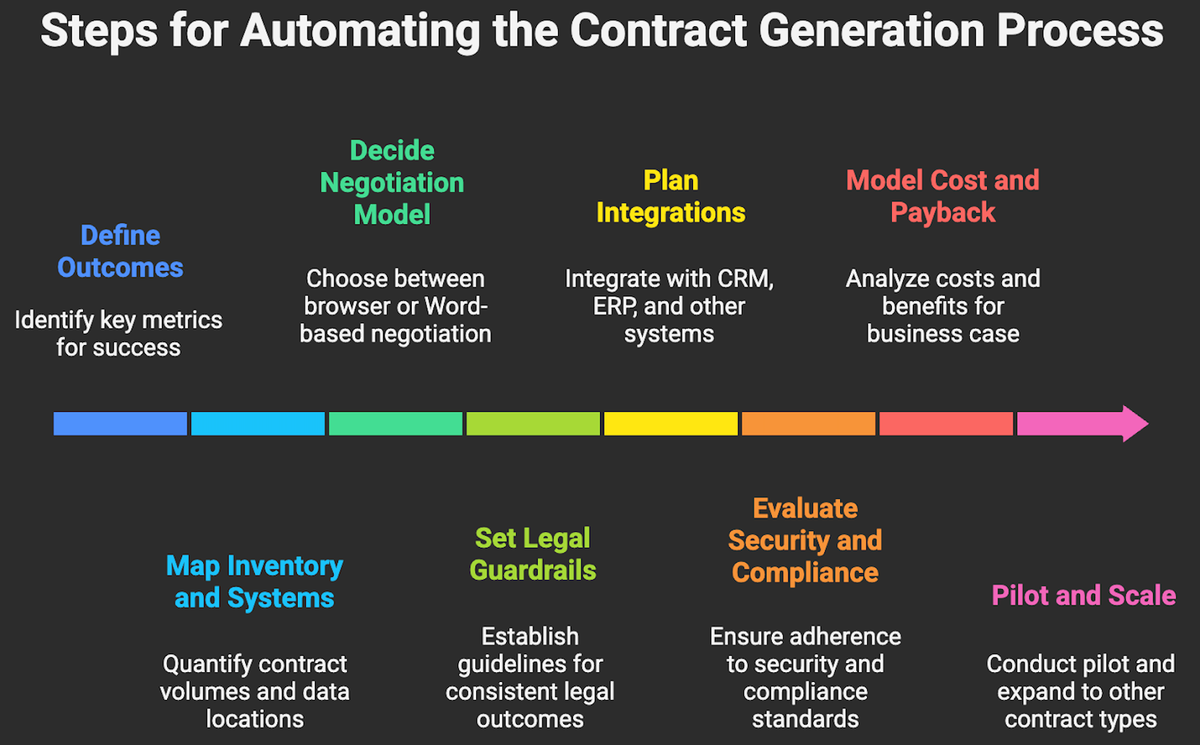
STEPS FOR GENERATING A CONTRACT USING A DEDICATED TOOL
- Define the outcomes. Target two or three metrics that matter, median cycle time from request to signature, percentage of standard terms usage, and manual touch points per contract.
- Map contract inventory and systems. Quantify monthly volumes by type, who initiates, where data lives, CRM, ERP, HRIS, and where obligations need to land.
- Decide on your negotiation model. Browser native collaboration versus Word first redlining. This choice narrows the field immediately.
- Set guardrails for Legal. Playbooks, clause libraries, fallback logic, and AI assistance should produce consistent outcomes without becoming a bottleneck.
- Plan the integrations. At minimum, CRM for sell side, ERP or P2P for buy side, identity and SSO, and a data destination for reporting. Prefer native connectors over custom builds.
- Evaluate security and compliance. SOC 2 Type II, ISO 27001, data residency, DLP, and admin controls appropriate to your industry.
- Model total cost and payback. License tiers, implementation, change management, and admin time. Anchor the business case on time saved, faster cash, lower external counsel spend, and risk reduction, and validate with a small pilot.
- Pilot and scale. Run a 60 to 90 day pilot on one high volume use case, freeze template scope, measure cycle time and exception rates weekly, and then scale to adjacent contract types.
HOW TO SAVE MORE TIME ON CONTRACT GENERATION?
The top contract generation tools share a goal, generate compliant contracts faster with fewer touches and less risk. Your best fit depends on where your bottleneck sits. If signature and scale are the constraint, DocuSign is a safe platform. If legal process design and negotiation discipline are the gap, Ironclad or Agiloft will give you control. If sales velocity drives the business, PandaDoc is hard to beat. If you want a clean, collaborative browser experience, Juro streamlines the flow.
A licence is only part of the cost. Test one real contract type and measure the time spent on intake, drafting, approvals and signing before deciding which platform fits.
Our document and contract automation services connect your chosen CLM or document platform with intake, clause governance, CRM, ERP and data warehouse workflows, so you get measurable ROI from contract generation. Feel free to explore our services. If you want to see what this looks like in practice, review our client results on the case studies page.
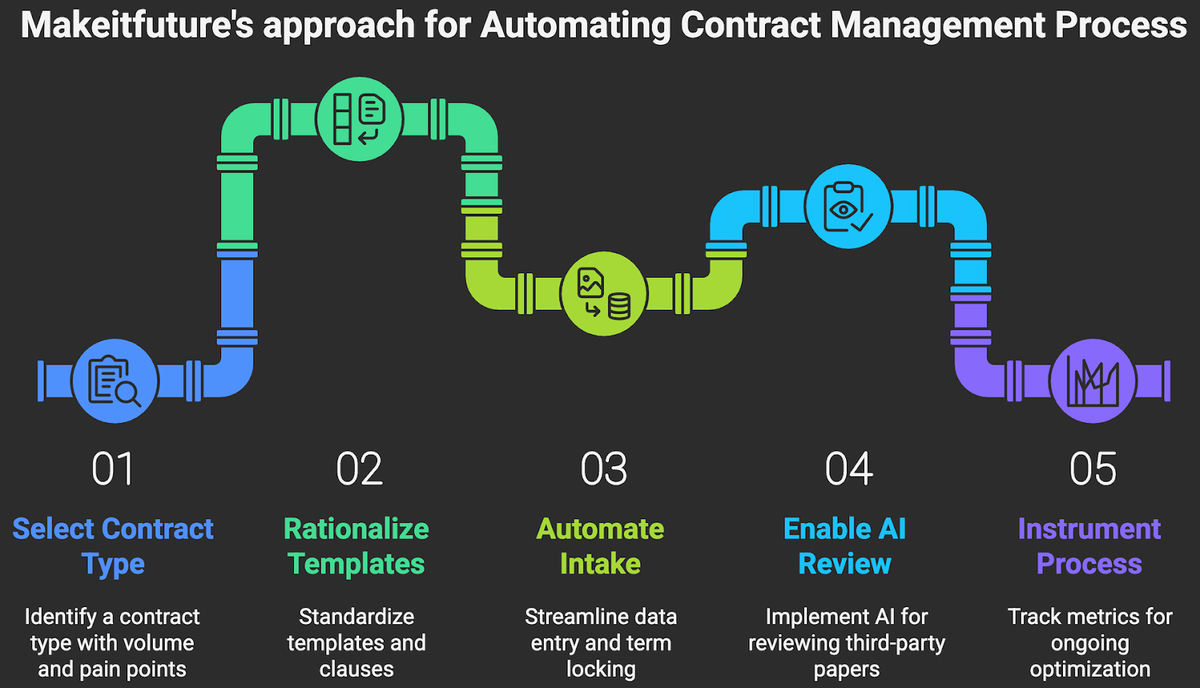
Implementation blueprint we typically run:
- Select one contract type with volume and pain, for example, order forms.
- Rationalize templates and clauses to one gold standard with fallbacks.
- Automate intake, map data from CRM or ERP to required fields, and lock terms based on business rules.
- Enable AI assisted review on third party paper with simple escalation paths.
- Instrument the process, cycle time, touch count, exception rates, and push the data to BI for ongoing optimization.
If you want a fast diagnostic to identify the 90 day wins, book an assessment with our team. We will map your top three use cases, the right tool fit from this list, and the automation sequence that pays back in quarter.